
Book Overview – Micah • 06.21.26

He Shall Be Their Peace
Micah Overview
- God exposes our false hopes
- God promises a shepherd-king
- God forms a different kind of people
- God’s mercy has the final word
Manuscript:
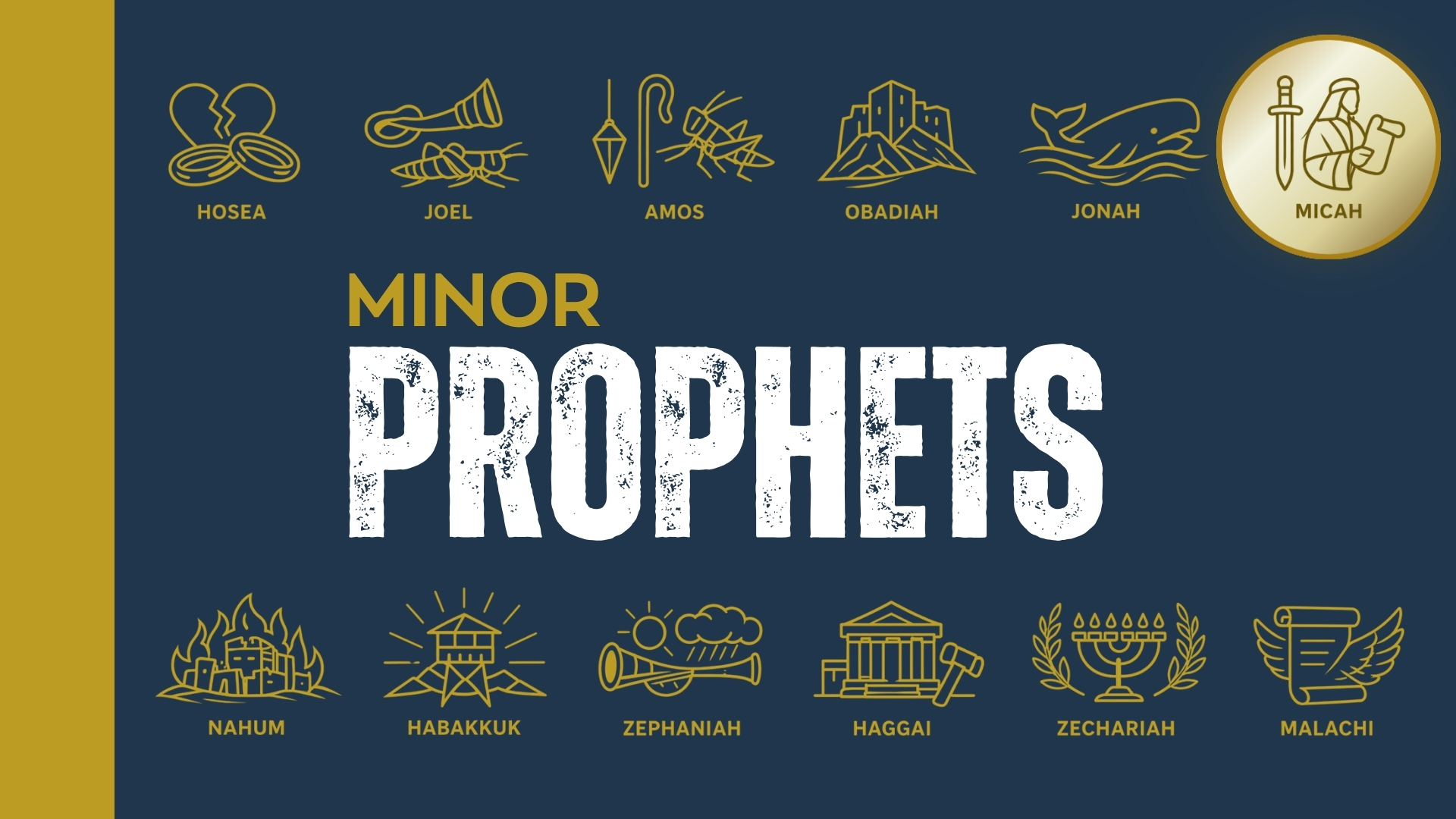
This morning we are stepping into the book of Micah. It is one of the twelve books we often call the Minor Prophets. They are not minor because they are unimportant, but because they are shorter than books like Isaiah, Jeremiah, and Ezekiel. Even so, they are not small in message. They are sharp, direct, and full of warning, grief, hope, judgment, mercy, and the promises of God.
Before we step into Micah’s message, we need to understand where we are in the story of Israel. Micah is preaching during the days of the divided kingdom. After the reigns of David and Solomon, the kingdom of Israel split in two. The northern kingdom kept the name Israel, was made up of ten tribes, and had Samaria as its capital. The southern kingdom was called Judah, was made up of the tribes Judah and Benjamin, and had Jerusalem as its capital. The timeline for the message is some length of time between 740 – 689 B.C., overlapping with the messages of Isaiah and Hosea.
Micah 1:1 helps us in this timeline: The word of the Lord that came to Micah of Moresheth in the days of Jotham, Ahaz, and Hezekiah, kings of Judah, which he saw concerning Samaria and Jerusalem. By the time Micah begins to preach, both kingdoms are spiritually unstable. Israel in the north has been marked by idolatry, corruption, false worship, and political compromise. Judah still has Jerusalem, the temple, the priesthood, and the line of David, but Judah is not spiritually healthy either. The people still have religious activity, but their hearts are drifting from the Lord. Leaders are abusing power. The wealthy are exploiting the vulnerable. Prophets are saying what people want to hear. Worship is continuing, but justice, mercy, and humility are being neglected. And outside the borders, the world is shifting. The Assyrian Empire is rising. Assyria will become the instrument of judgment against the northern kingdom of Israel. Samaria will fall, and the northern kingdom will be carried away into exile.
Micah is not merely commenting on current events. He is speaking the word of the Lord to a nation about to face the consequences of its rebellion. But Micah’s prophecy does not stop with the northern kingdom. He also warns Judah. Jerusalem may assume it is safe because it has the temple and the traditions of worship, but outward religion cannot protect an unrepentant people. Judgment is also coming for Judah. The immediate threat is Assyria, but Micah looks ahead and speaks of a future exile to Babylon. That is the world Micah is preaching into: a divided kingdom, compromised worship, corrupt leadership, rising empires, and coming judgment. But Micah is not simply giving a history lesson or political commentary. He is interpreting the moment through the word of the Lord. Assyria may be the visible threat. Babylon may be the coming exile. Corrupt leaders may be the immediate problem. But underneath it all is a deeper issue: God’s people have turned from Him, and yet God has not abandoned His covenant promises.
That is why the book of Micah moves the way it does. It does not move in a straight line from problem to solution. It warns, then it promises. It exposes sin, then it announces hope. It confronts false security, then it points to mercy. One helpful way to see the book is in three major sections, each beginning with a call to “hear” or “listen.” Micah 1–2 announces judgment against Samaria and Jerusalem and exposes idolatry, greed, and the abuse of power. The people with influence are using their strength to take from others, and God declares that He sees it. Micah 3–5 focuses especially on corrupt leaders, prophets, and rulers, but in the middle of that failure, God gives one of the great promises of the book. Micah 6–7 has the feel of a covenant lawsuit. God brings His case against His people, reminding them of His faithfulness and calling them back to true covenant life. Micah’s literary style is vivid, poetic, and direct. He uses courtroom language, images of mountains melting, shepherds gathering sheep, rulers devouring the people, and sins being cast into the depths of the sea. The book is intense because Micah is pleading with God’s people. He grieves over their sin, confronts their false security, warns of judgment, and lifts their eyes to God’s mercy and promises.
And that makes Micah very relevant for us. Because Micah asks questions that are still searching questions today. What do we trust in? What do we hide behind? What does God see when He looks past our religious activity and into our hearts? What kind of King do we really need?And what kind of people does God form under the rule of that King? This morning, we are not just studying an ancient prophet or Israel’s history. We are listening to the Word of the Lord expose the things people still trust in, point us to the King God promised to send, and show us the kind of life His mercy creates.
Micah gives us a clear movement through the book: false hopes are exposed, a faithful King is promised, and God’s mercy forms His people. So the main idea this morning is this: False Hopes, a Faithful King, and the Mercy That Forms His People
Let’s begin where Micah begins.
1. God Exposes Our False Hopes
Micah does not begin with comfort. He begins with a summons. Micah 1:2 says:
Hear, you peoples, all of you; pay attention, O earth, and all that is in it, and let the Lord GOD be a witness against you, the Lord from his holy temple. Here, the prophet calls all peoples to hear, and he pictures the Lord God Himself as a witness against His people from His holy temple. This is courtroom language. God is not offering casual advice. He is bringing a charge. He sees what is happening among them, and He will not pretend their sin is harmless.
Micah 1:3–5 continues:
For behold, the LORD is coming out of his place, and will come down and tread upon the high places of the earth. And the mountains will melt under him, and the valleys will split open, like wax before the fire, like waters poured down a steep place. All this is for the transgression of Jacob and for the sins of the house of Israel.
Micah is telling us that God is not distant from the sins of His people. He sees. He knows. He comes as Judge. And what are the sins Micah confronts? They are not abstract. They are very specific. In Micah 2:1–2, he says:
Woe to those who devise wickedness and work evil on their beds! When the morning dawns, they perform it, because it is in the power of their hand. They covet fields and seize them, and houses, and take them away; they oppress a man and his house, a man and his inheritance.
These are people with power using that power for themselves. They lie awake at night making plans, and in the morning they carry them out because they can. They take land. They take houses. They take advantage of the vulnerable. Micah is confronting greed, injustice, and people who use power without love for God or neighbor. In chapter 3, Micah turns to leaders, priests, and prophets. Micah 3:9–11 says:
Hear this, you heads of the house of Jacob and rulers of the house of Israel, who detest justice and make crooked all that is straight, who build Zion with blood and Jerusalem with iniquity. Its heads give judgment for a bribe; its priests teach for a price; its prophets practice divination for money; yet they lean on the LORD and say, “Is not the LORD in the midst of us? No disaster shall come upon us.”
That last line is haunting. They are corrupt. They are unjust. They are using religion for gain. But they are still saying, “Is not the Lord in the midst of us?” In other words, they assume they are safe because they have religious identity. They assume God must be with them because they have the temple, the priesthood, the sacrifices, the traditions, the language, the history.
They have the appearance of belonging to God, but their hearts are far from Him. That is one of Micah’s central concerns. He is not confronting people who have abandoned all religion, but people who have kept religious appearance while rejecting the heart of God. And that is exactly why Micah connects so clearly with the messages from our series on Luke this year. In Luke, Jesus repeatedly confronts this same danger. In Luke 6, Jesus says: Why do you call me “Lord, Lord,” and not do what I tell you?
In Luke 7, the religious leaders struggle with Jesus because He receives sinners. In Luke 10, Jesus tells a parable where the shocking example of neighbor-love is not the priest or the Levite, but an outsider who shows mercy. In Luke 11, Jesus says to the Pharisees:
But woe to you Pharisees! For you tithe mint and rue and every herb, and neglect justice and the love of God.
That sounds like Micah. Jesus is not impressed by religious precision that lacks justice or fooled by outward cleanliness when the inside is full of greed and wickedness. He does not accept religious identity as a substitute for repentance, faith, and love. Micah and Luke press on the same nerve.
It is possible to be very religious and still be far from God.
It is possible to say the right words and still trust the wrong things.
It is possible to know the language of faith and still be building your life around power, comfort, reputation, control, or money.
That was the issue in Micah’s day. That was the issue in Jesus’ day. And brothers and sisters, it is still an issue in our day.
We may not seize fields in the way Micah describes. But we know what it is to want control. We know what it is to protect our own interests. We know what it is to look spiritual while resisting surrender.
So we see, Micah exposes our false hopes:
• the false hope that religious activity can cover an unrepentant heart.
• the false hope that power can secure us.
• the false hope that wealth can protect us.
• the false hope that being near the things of God is the same as walking with God.
And that is a mercy. It does not always feel like mercy when God exposes us. But God wounds in order to heal. He tears down false hopes so that we might receive true hope. And that brings us to the heart of the book. Micah’s message is not only judgment. It is also promise. In the middle of corruption, judgment, exile, fear, and failure, God speaks a word of hope.
Micah 5:2–5:
But you, O Bethlehem Ephrathah, who are too little to be among the clans of Judah, from you shall come forth for me one who is to be ruler in Israel, whose coming forth is from of old, from ancient days. Therefore he shall give them up until the time when she who is in labor has given birth; then the rest of his brothers shall return to the people of Israel. And he shall stand and shepherd his flock in the strength of the LORD, in the majesty of the name of the LORD his God. And they shall dwell secure, for now he shall be great to the ends of the earth. And he shall be their peace.
2. God Promises a Shepherd-King
Micah says that God will bring forth a ruler for Israel. This ruler is not ordinary. His coming is tied to ancient promise, and His reign will not be marked by exploitation, corruption, or fear. He will stand and shepherd His flock in the strength of the Lord. His greatness will reach to the ends of the earth. And Micah says, He shall be their peace. From Bethlehem. Not the center of political power. Not the obvious place. Micah says it is “too little to be among the clans of Judah.” It is insignificant by worldly standards. But this is so often how God works.
God delights to bring great things from small places. He delights to use what the world overlooks. God delights to humble the proud and lift up the lowly. That theme should sound familiar from our study of Luke. In Luke 1, Mary praises God because He brings down the proud and lifts up the humble. The world looks for power, status, and control. God sends His King through a young woman of no worldly prominence, into a small town, in humility.
In Luke 2, Joseph and Mary travel to Bethlehem, and Jesus is born there. Luke wants us to see that the birth of Jesus is not random. It is fulfillment. The child born in Bethlehem is the promised King. Micah said a ruler would come from Bethlehem. Luke shows us Jesus born in Bethlehem. Micah said He would shepherd His people. Luke shows Jesus gathering the poor, the sick, the sinful, the overlooked, and the burdened. Micah said He would be their peace. Luke records the angelic announcement of peace at Jesus’ birth. This is the heart of Micah’s hope.
God’s answer to corrupt leadership is not merely better leadership principles.
God’s answer to injustice is not merely a new policy.
God’s answer to human sin is not merely moral improvement.
God’s answer is a King.
This is why Micah 5 is so important. The hope of God’s people is not found in their ability to reform, rescue, or secure themselves. Their hope is found in the ruler God promises to send. And Luke shows us that this ruler is Jesus. In Luke 4, Jesus announces good news to the poor, liberty to captives, sight to the blind, and freedom for the oppressed. In Luke 5, He forgives sin and calls Levi the tax collector to follow Him. When questioned for eating with tax collectors and sinners, Jesus says He came not to call the righteous but sinners to repentance. In Luke 10, mercy moves toward need, crosses boundaries, interrupts convenience, and reflects the heart of God. That is the kind of King Micah promised, and that is the King Luke reveals. Micah’s world was full of leaders who used people. Jesus is the King who gives Himself for people. Micah’s world was full of shepherds who devoured the flock. Jesus is the Shepherd who gathers the flock. Micah’s world was full of false peace built on denial. Jesus is true peace because He deals with sin at its root.
And that phrase in Micah 5 matters: He shall be their peace.
Not merely, “He will give them peace,” though that is true.
Not merely, “He will announce peace,” though that is also true.
Micah says He Himself will be their peace.
That means peace is not first a circumstance. Peace is a person. Peace is not ultimately found when everything around us becomes easy or when we finally gain control. Peace is not ultimately found when our reputation is secure, our finances are stable, our family is healthy, our future is predictable, and our enemies are quiet. Those are good gifts, but they are not ultimate peace. Our peace is found in the King God has sent. This also gives us a bridge to our next sermon series in Ephesians as we consider what it means to be “In Him,” Micah helps us see why that phrase matters. God’s blessings are not abstract. They are found in the promised King. Forgiveness is in Him. Redemption is in Him. Peace is in Him. Identity is in Him.
So the question Micah presses on us is simple: Where are you looking for peace? Are you looking for peace in control? In religious appearance? In approval? In comfort? In power? In being right? In being respected? Micah tells us that none of those things can carry the weight of our hope. God has given us something better. He has given us the Shepherd-King from Bethlehem. And He shall be our peace.
3. God Forms a Different Kind of People
If Micah 5 gives us the heart of the promise, Micah 6 shows us the shape of the response. God promises a Shepherd-King from Bethlehem. One who will stand and shepherd His flock in the strength of the Lord, One who will be their peace. But then Micah presses the question: What kind of people should live under the rule of that King?
Micah 6:1-8: Hear what the Lord says:
Arise, plead your case before the mountains, and let the hills hear your voice. 2 Hear, you mountains, the indictment of the Lord, and you enduring foundations of the earth, for the Lord has an indictment against his people, and he will contend with Israel. 3 “O my people, what have I done to you? How have I wearied you? Answer me! 4 For I brought you up from the land of Egypt and redeemed you from the house of slavery, and I sent before you Moses, Aaron, and Miriam. 5 O my people, remember what Balak king of Moab devised, and what Balaam the son of Beor answered him, and what happened from Shittim to Gilgal, that you may know the righteous acts of the Lord.” “With what shall I come before the Lord, and bow myself before God on high? Shall I come before him with burnt offerings, with calves a year old? Will the Lord be pleased with thousands of rams, with ten thousands of rivers of oil? Shall I give my firstborn for my transgression, the fruit of my body for the sin of my soul?” He has told you, O man, what is good; and what does the Lord require of you but to do justice, and to love kindness, and to walk humbly with your God?
It sounds like a courtroom scene. God brings a covenant case against His people. He calls them to remember His faithfulness. He reminds them that He delivered them from Egypt, redeemed them from slavery, and led them through the wilderness. Before God tells His people what He requires, He reminds them what He has already done. That order matters. God does not begin with human performance. He begins with divine grace. He does not say, “Obey Me so I might redeem you.” He says, “I have redeemed you; now walk with Me.” That is important for understanding Micah 6:8. This verse is one of the best-known verses in the Minor Prophets, but it is often misunderstood when separated from the rest of the book.
Micah 6:8 is not a self-improvement plan. It is not a generic moral slogan. It is not a way to earn acceptance before God. It is the life God forms in a redeemed people. Micah asks what the Lord requires, and the answer is simple, searching, and deeply challenging: God calls His people to do justice, love kindness, and walk humbly with Him. Let’s take those one at a time. First, do justice. In Micah’s context, this directly confronted the sins we have already seen. People were using power to take what did not belong to them. Leaders were twisting justice. Prophets and priests were serving for personal gain. The vulnerable were being crushed while the powerful protected themselves. So when God says to do justice, He is not talking about a vague interest in fairness. He is calling His people to live rightly before Him and toward others.
Justice means we do not use people. Justice means we do not bend truth for personal gain. Justice means we care about what is right, even when it costs us. Justice means we do not close our eyes to the vulnerable, the overlooked, or the wounded. Justice is not merely a social issue. It is a discipleship issue. It is a worship issue. It is a heart issue. The people of God are meant to reflect the character of God. And God is just.
Second, love kindness. The word here carries the idea of covenant mercy, steadfast love, loyal compassion. It is not merely being polite. Or occasionally nice when it is convenient. It is a settled love for mercy because God Himself is merciful. This would have cut deeply into Micah’s audience. They loved gain. They loved security. They loved religious appearance. They loved having the advantage. But God calls them to love mercy. Not merely to perform mercy, to approve of mercy, or to admire mercy from a distance. To love it. That means mercy becomes precious to us. We delight to show compassion because we have received compassion. We forgive because we have been forgiven. We are patient because God has been patient with us.
Third, walk humbly with your God. This is the foundation of the other two. To walk humbly with God means we live in surrendered dependence. We stop pretending we are self-made, self-sufficient, and self-righteous. Humility is not thinking we are worthless. It is seeing ourselves truthfully before God. He is Creator. We are creatures. He is holy. We are sinners. He is Redeemer. We are recipients of mercy. He is Shepherd. We are sheep. He is King. We are His people. To walk humbly with God means daily life with God, under God, and before God. And this is where Micah connects beautifully to Luke. In the first part of Luke, we have seen Jesus form this kind of people.
Luke begins with humble people receiving the promises of God. Mary receives the word of the Lord with humility. Zechariah’s song celebrates God’s mercy and covenant faithfulness. Simeon and Anna wait for Israel’s consolation and redemption. They are not impressive by worldly standards, but they are looking to God. Then Jesus begins His ministry and announces good news to the poor, liberty to captives, sight to the blind, and freedom for the oppressed. He is not gathering the powerful around self-exaltation. He is gathering the needy around the mercy of God. Jesus is just. Jesus is merciful. Jesus walks in perfect humility before the Father. And He forms His followers into people who reflect His heart.
In Luke 6, Jesus teaches His disciples to love their enemies, do good, be merciful as their Father is merciful, judge with humility, and bear fruit from a transformed heart. Again, that sounds like Micah. Do justice. Love mercy. Walk humbly. But here is where we need to be careful. Micah 6:8 can crush us if we treat it as the way we make ourselves acceptable to God. Because who among us has perfectly done justice? Who among us has loved mercy as we should? Who among us has walked humbly with God every day, in every thought, every word, every decision, every relationship? We have not. We are often selective with justice. We are often stingy with mercy. We are often proud in ways we barely recognize. So if Micah 6:8 is simply a ladder we climb to reach God, we are lost. But that is not the message of Micah.
Micah 6:8 comes in a book that has already promised a Shepherd-King and will end with God pardoning sin and delighting in steadfast love. It comes in the larger story of Scripture that leads us to Jesus Christ, the only One who has perfectly done justice, loved mercy, and walked humbly with God. He did justice without cruelty. He loved mercy without compromise. He walked humbly without weakness. He obeyed the Father fully. He loved sinners truly. He confronted evil rightly. He gave Himself willingly. And now, under His rule, He forms His people into a different kind of people.
So Micah 6:8 is not the root of our salvation. It is the fruit of God’s redeeming work. This is where we lightly begin to look toward Ephesians. Next week, we will begin considering what it means to be in Christ. And one of the things Ephesians will make clear is that we are saved by grace, not by works, but we are also created in Christ Jesus for good works. Micah gives us a picture of the kind of good works that flow from a redeemed life.
Justice. Mercy. Humility. Not as performance to earn God’s love, image management to impress others, or religious activity to hide an unchanged heart. But as the life of people who belong to the Shepherd-King. This presses some honest questions on us. Where are we tempted to care more about being seen as right than actually doing what is right? Where are we tempted to love the idea of mercy but resist showing mercy when it costs us? Where are we keeping up religious appearance while resisting humble surrender to God? Where are we using our words, influence, money, knowledge, or position for ourselves rather than for the good of others?
Micah does not let us keep justice, mercy, and humility as decorative words on a wall. He brings them into our homes, our church, work, relationships, calendars, wallets, conversations, and our private thoughts. But he does not bring them there to condemn those who are in Christ. He brings them there because the Shepherd-King is forming a people who reflect His heart. A people who do justice because their King is just. A people who love mercy because their King is merciful. A people who walk humbly because their King came in humility. Micah’s question is not merely, “Are you trying harder?” The deeper question is: Are you living under the rule of the Shepherd-King? Because where Jesus reigns, He changes what we love, what we pursue. He changes how we see people, how we use power, and how we respond to need. He changes how we walk with God.
Micah 6:8 shows us the shape of that changed life.
God promises a Shepherd-King. And under that King, God forms a different kind of people. Micah has exposed false hopes, promised a Shepherd-King, and shown us the kind of people God forms under the rule of that King. But Micah does not end by pointing us to ourselves. After all the calls to justice, mercy, and humility, Micah does not end by saying, “Now go prove yourself.” He does not end with human obedience as the final word. He ends with the mercy of God.
That brings us to Micah 7:18–20.
Who is a God like you, pardoning iniquity and passing over transgression for the remnant of his inheritance? He does not retain his anger forever, because he delights in steadfast love. He will again have compassion on us; he will tread our iniquities underfoot. You will cast all our sins into the depths of the sea. You will show faithfulness to Jacob and steadfast love to Abraham, as you have sworn to our fathers from the days of old. This is one of the most beautiful conclusions in the Minor Prophets. Micah ends with a question of worship: Who is a God like You? That question is actually connected to Micah’s name. The name Micah means something like, “Who is like the Lord?” And at the end of the book, Micah answers not by pointing first to God’s power, though God is powerful. Not by pointing first to God’s knowledge, though God knows all things. Not by pointing first to God’s judgment, though God is just. Micah says there is no one like the Lord because He pardons sin. God’s uniqueness is displayed in His mercy. This is our final point:
4. God’s Mercy Has the Final Word
Think about where this book has taken us. Micah has not minimized sin. He has named it directly. He has confronted greed, injustice, corrupt leadership, false prophecy, empty religion, and proud self-confidence. He has announced real judgment. He has told the truth about the people of God. So when Micah ends with mercy, it is not because sin was no big deal. That is cheap mercy. That is the kind of mercy that shrugs and says, “It does not really matter.” But biblical mercy is deeper than that. God’s mercy does not ignore sin. God’s mercy deals with sin. Micah says God pardons iniquity. He passes over transgression. He does not retain His anger forever. He delights in steadfast love. He has compassion. He subdues our iniquities. He casts sins into the depths of the sea. He keeps covenant promises. Micah piles up words of mercy because one phrase is not enough. This is not reluctant mercy. God is not pictured as tight-fisted with grace, as though sinners have to pry compassion out of His hands. He delights in steadfast love. Mercy is not contrary to His character. Mercy flows from His character. That does not mean mercy is automatic pardon for those who remain hardened in sin. Micah has been calling the people to hear the word of the Lord, to return to Him, and to walk humbly before Him. God’s mercy is not permission to continue in rebellion. It is an invitation to come home. But here is the comfort: the repentant sinner does not need to wonder whether God is willing to pardon. The sinner who turns to Him in faith will not find Him reluctant, cold, or unwilling to forgive.
Who is a God like this? This connects so clearly to Luke. In Luke’s Gospel, Jesus shows us the mercy of God in person. In Luke 1, Zechariah praises God because He has visited and redeemed His people. He speaks of salvation, forgiveness, and the tender mercy of our God. That is Micah 7 language brought forward into the coming of Christ. In Luke 2, the angels announce peace because the Savior has been born. The mercy promised through the prophets is now arriving in a person. In Luke 5, Jesus looks at a paralyzed man and declares his sins forgiven. The religious leaders ask the right theological question, even though their hearts are hard: Who can forgive sins but God alone?
That is exactly the point. If Micah asks, “Who is a God like You, pardoning iniquity?” Luke shows Jesus standing there, forgiving sin with divine authority. Jesus is not merely talking about God’s mercy. He is bringing God’s mercy. Jesus moves toward guilty people. He calls sinners. He forgives the undeserving. Jesus does not excuse sin, but He does not avoid sinners. In Luke 7, a sinful woman comes to Jesus. She is known for her sin. Everyone in the room knows her reputation. The religious host sees her as a problem. Jesus sees her as a woman in need of mercy. And Jesus sends her away forgiven and at peace. Again, Micah says, “He shall be their peace.” So Micah’s ending is not detached from the rest of the book. It completes it. God exposes sin. God promises a King. God forms a people. God pardons sinners. And without this final note of mercy, the rest of the sermon would either crush us or turn us into moral performers. Because if Micah only says, “God sees your false hopes,” we would be exposed but not healed. If Micah only says, “God calls you to justice, mercy, and humility,” we might either despair because we fail or become proud because we think we are doing better than others. But Micah ends by lifting our eyes to the character of God.
Who is a God like this? A God who tells the truth and still shows mercy. A God who judges evil and still pardons sinners. A God who confronts His people and still keeps covenant. A God who disciplines and still delights in steadfast love. A God who does not pretend sin is harmless, but also does not abandon His people to it. This is where we see the gospel most clearly. Micah sees the mercy of God from the prophetic side of the cross. He knows God pardons. He knows God keeps covenant. He knows God casts sin away. But from where we stand, we see how God does it. He does it through Jesus Christ. The Shepherd-King from Bethlehem does not merely announce peace. He makes peace. And He makes peace by going to the cross. At the cross, God does not ignore sin. He judges it. At the cross, God does not abandon sinners. He saves them. At the cross, justice and mercy meet. At the cross, God remains holy, and sinners are forgiven. At the cross, the Shepherd lays down His life for the sheep. This is why Micah can say God casts sin into the depths of the sea.
For those who are in Christ, your sin is not floating near the surface waiting for God to bring it back up. It is not sitting in a file for later use. It is not hanging over you as the truest thing about you. If you belong to Christ, your sin has been dealt with. Not because you have done enough. Not because you have been religious enough. Not because you have made up for it. Not because you have balanced the scales. Because Jesus is enough.
Our identity is not found in our false hopes. Not in power. Not in performance. Not in religious appearance. Not in our ability to prove ourselves. Not even in our failure and shame. Our identity is found in the mercy of God given to us through the Shepherd-King. So let Micah 7 press this into your heart: God delights in steadfast love. Some of us believe God is merciful in theory, but we struggle to believe He is merciful toward us. We can believe He forgave people in the Bible. We can believe He forgives other people in the church. We can believe mercy is a true doctrine. But when we look at our own sin, our own past, our own repeated failures, our own hidden struggles, we wonder if God is still willing.
Micah says: look at who God is. He pardons. He has compassion. He delights in steadfast love. He keeps His promises. Who is a God like this? There is no one like Him. And if that is true, then mercy should not only comfort us. It should also change us. If God has pardoned us, how can we become people who refuse to forgive? If God has had compassion on us, how can we become people who are cold toward weakness? If God delights in steadfast love, how can we treat mercy as an inconvenience? If God has cast our sins away, how can we keep defining ourselves by what Christ has already dealt with? God’s mercy has the final word, but it is not a passive word. It is a transforming word. It frees us from pretending. It frees us from hiding. It frees us from self-righteousness. It frees us from despair. It frees us to confess sin honestly because we know God is merciful. It frees us to pursue justice without pride. It frees us to love mercy without fear. It frees us to walk humbly because we are no longer trying to save ourselves.
This is the beauty of Micah. The book begins with God coming as witness against His people. But it ends with God showing mercy to His people. The book begins by exposing sin. But it ends by celebrating pardon. The book begins with judgment. But it ends with covenant love. And at the center stands the promise of the Shepherd-King from Bethlehem. So as we close, hear the movement of the whole book: God exposes our false hopes. God promises a Shepherd-King. God forms a different kind of people. And God’s mercy has the final word. That is not only the message of Micah. That is the message that leads us to Jesus. He is the King born in Bethlehem. He is the Shepherd who gathers sinners. He is the One who becomes our peace. He is the mercy of God for the guilty. He is the One in whom our hope, forgiveness, peace, and life are found. So come out from false hopes. Do not hide behind religious appearance. Do not look to power, control, comfort, or performance to save you. Look to the Shepherd-King. And if you belong to Him, walk as His people. Do justice. Love mercy. Walk humbly with your God. Not to earn His love. Because in Christ, you have received it. And because His mercy has the final word.